

Call for Papers (CFP) – Special Issue 2026
Theme:
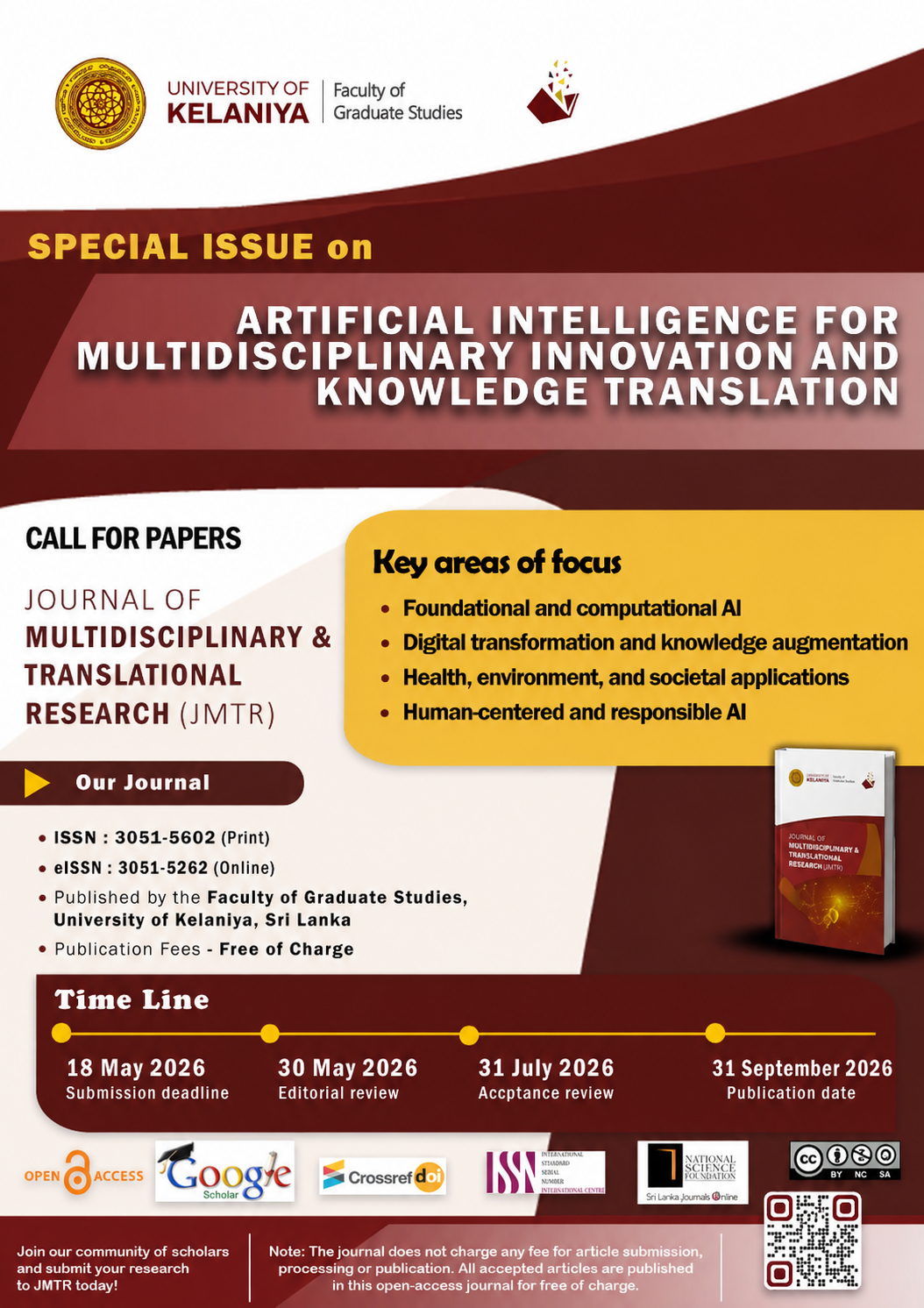
Artificial Intelligence for Multidisciplinary Innovation and Knowledge Translation
The Journal of Multidisciplinary and Translational Research (JMTR), an open-access, peer-reviewed journal published by the Faculty of Graduate Studies, University of Kelaniya, Sri Lanka, invites submissions for a Special Issue on “Artificial Intelligence for Multidisciplinary Innovation and Knowledge Translation.”
Important Dates:
| Submission Deadline | 18th May 2026 |
| Editorial Review | 30th May 2026 |
| Acceptance Notification | 31st July 2026 |
| Publication Date | 30th September 2026 |
Publication Fees - No Article Processing Charges (APC).
Guidelines for Authors
Authors interested in submitting manuscripts to the Journal of Multidisciplinary and Translational Research (JMTR) are kindly requested to carefully review the journal’s submission guidelines before preparing their manuscripts. Detailed information regarding manuscript preparation, formatting requirements, submission procedures, and publication policies is available through the following links. These guidelines provide essential instructions to ensure that submissions meet the journal’s editorial and publication standards.
-
Author Guidelines:
https://journals.kln.ac.lk/jmtr/index.php/guidelines/author-guidelines
-
Submission Process:
https://journals.kln.ac.lk/jmtr/index.php/guidelines/submissions-process
-
Article Processing Charges:
https://journals.kln.ac.lk/jmtr/index.php/guidelines/article-processing-charges
Authors are encouraged to follow these guidelines carefully to facilitate a smooth review and publication process.
Editorial Team
Lead Editor




Prof. P.A.D.H. Nayana Gunathilaka
ProfessorDept. of Parasitology, Faculty of Medicine, University of Kelaniya.
PhD (Kelaniya, SL)
BSc (Hons)
MI Biol (SL)
C. Biol (SL
Honorary Editor


Prof. Yahya Abid
Associate ProfessorDept. of Electrical & Communications Systems Engineering, School of Electrical & Mechanical Engineering, Botswana International University of Science and Technology, Botswana.
PhD (Malaysia)
MSc (Malaysia)
BSc (Pakistan)
Editor

Prof. B.M.T. Kumarika
ProfessorDept. of Statistics & Computer Science, Faculty of Science, University of Kelaniya, Sri Lanka.
PhD (GSU, USA)
MSc (USA)
BSc(Hons), Kelaniya, SL
Editor

Prof. (Ms.) K.S.D. Fernando
ProfessorDept. of Computational Mathematics, Faculty of Information Technology, University of Moratuwa.
BSc (Special) (Hons.) (Kelaniya)
MEng (NUT, Japan)
DrEng (NUT, Japan)
MCSSL, MIEEE
Editor

Dr. Kaumudee Kodikara
Senior Lecturer (Grade II)Dept. of Medical Education, Faculty of Medicine, University of Kelaniya, Sri Lanka.
PhD
Master of Medical Education (Post Graduate Institute of Medicine, Colombo)
MBBS (Kelaniya, SL)
Editor

Mr.Ranitha Weerarathna
Senior LecturerSLIIT Business School, Sri Lanka Institute of Information Technology, Sri Lanka.
Reading for PhD (Swinburne University of Technology)
MBA (University of Sunderland)
Master’s (University of Colombo)
PGDip HRM (Indian Institute of Management and Technology)
Bachelor’s (Kelaniya, SL)
Rationale and Justification
The Journal of Multidisciplinary and Translational Research (JMTR) has established itself as a platform for scholarship that bridges disciplinary boundaries and translates research into practice. As the Faculty of Graduate Studies, University of Kelaniya, Sri Lanka, prepares to seek Scopus indexing for JMTR in the coming year, it is imperative to strategically enhance the visibility of the journal to attract high-quality submissions and increase citation impact. One proven pathway to achieve this is through the introduction of a special issue on a globally relevant and highly cited theme. Artificial Intelligence (AI) represents precisely such a theme, given its transformative influence across disciplines and its prominence in contemporary academic discourse.
AI has rapidly evolved from a niche area of computer science into a cross-cutting technology that permeates medicine, engineering, environmental sciences, social sciences, and governance. Leading journals and publishers, including Frontiers in Artificial Intelligence, Journal of Computational Design and Engineering (Oxford), Journal of Innovation and Knowledge (Elsevier), and Taylor & Francis outlets on human-centred AI, have all launched special issues on AI, reflecting its interdisciplinary relevance and citation potential. These initiatives demonstrate that AI-related publications consistently attract significant scholarly attention, with citation rates far exceeding those of many traditional disciplinary topics. By aligning JMTR with this global trend, the journal can position itself as a hub for multidisciplinary AI research, thereby strengthening its case for Scopus indexing.
The rationale for this proposal rests on several pillars. First, AI is not only a technological innovation but also a translational enabler it accelerates the movement of knowledge from research to practice. Whether in healthcare diagnostics, climate modelling, computational design, or governance frameworks, AI serves as a bridge between theoretical advances and real-world applications. This translational emphasis resonates directly with JMTR’s mission. Second, AI is inherently multidisciplinary. It draws upon computer science, mathematics, engineering, cognitive science, ethics, law, and social sciences, while simultaneously impacting medicine, agriculture, education, and environmental sustainability. This breadth ensures that a special issue on AI will attract contributions from diverse fields, thereby enriching the content and expanding its readership in the journal. Third, AI is a national and global priority. Sri Lanka, like many countries, is investing in AI for innovation, sustainable development, and resilience. Hosting a special issue on AI will align JMTR with these priorities, enhancing its relevance to policymakers, practitioners, and international collaborators.
AI has rapidly evolved from a niche area of computer science into a cross-cutting technology that permeates medicine, engineering, environmental sciences, social sciences, and governance. Leading journals and publishers, including Frontiers in Artificial Intelligence, Journal of Computational Design and Engineering (Oxford), Journal of Innovation and Knowledge (Elsevier), and Taylor & Francis outlets on human-centred AI, have all launched special issues on AI, reflecting its interdisciplinary relevance and citation potential. These initiatives demonstrate that AI-related publications consistently attract significant scholarly attention, with citation rates far exceeding those of many traditional disciplinary topics. By aligning JMTR with this global trend, the journal can position itself as a hub for multidisciplinary AI research, thereby strengthening its case for Scopus indexing.
The rationale for this proposal rests on several pillars. First, AI is not only a technological innovation but also a translational enabler it accelerates the movement of knowledge from research to practice. Whether in healthcare diagnostics, climate modelling, computational design, or governance frameworks, AI serves as a bridge between theoretical advances and real-world applications. This translational emphasis resonates directly with JMTR’s mission. Second, AI is inherently multidisciplinary. It draws upon computer science, mathematics, engineering, cognitive science, ethics, law, and social sciences, while simultaneously impacting medicine, agriculture, education, and environmental sustainability. This breadth ensures that a special issue on AI will attract contributions from diverse fields, thereby enriching the content and expanding its readership in the journal. Third, AI is a national and global priority. Sri Lanka, like many countries, is investing in AI for innovation, sustainable development, and resilience. Hosting a special issue on AI will align JMTR with these priorities, enhancing its relevance to policymakers, practitioners, and international collaborators.
Objectives
The proposed special issue on AI in JMTR will pursue the following objectives.
| Key objective | Rationale |
| Enhance visibility and global Impact | To strategically increase the visibility, citation impact, and international profile of the journal by publishing high-quality, widely relevant papers on Artificial Intelligence. This objective emphasizes attracting contributions from both local and international scholars, ensuring that JMTR becomes a recognized platform for cutting-edge AI research across disciplines. |
| Promote multidisciplinary and translational research | To provide a platform for dialogue and collaboration among researchers from diverse fields including medicine, engineering, environmental sciences, social sciences, and humanities using AI as a unifying thread. This objective highlights the mission to translate theoretical advances into practical applications, showcasing how AI can accelerate innovation, resilience, and knowledge transfer across sectors. |
| Advance responsible and ethical AI for societal benefit | To encourage scholarship that critically examines the ethical, legal, and governance dimensions of AI, ensuring that technological advances are accompanied by responsible practices. This objective highlights the importance of human-centered AI, fairness, transparency, and accountability, while also addressing cultural and psychological dimensions of AI adoption |
Key areas of focus
The special issue will invite contributions across a broad spectrum of subject fields, organized into four key areas of focus as indicated below but not limited to:
-
Foundational and computational AI
This area will cover the core technical advances in AI, including machine learning, deep learning, natural language processing, robotics, computer vision, reasoning, planning, and generative AI. It will also include AI-driven computational design, optimization, and human–AI collaboration in engineering contexts. By incorporating foundational research, the special issue will ensure that JMTR engages with the cutting edge of AI science.
-
Digital transformation and knowledge augmentation
The AI is a driver of digital transformation across industries, organizations, and educational systems. This area will focus on AI in business analytics, finance, organizational innovation, and knowledge management. It will also cover AI in education, including adaptive learning systems, multilingual translation, and equitable access to knowledge. By highlighting AI’s role in augmenting human knowledge and transforming institutions, the special issue will resonate with both academic and practitioner audiences.
-
Health, environment, and societal applications
The impact of AI on health and environment is profound. This area will include AI in healthcare diagnostics, genomics, epidemiology, mental health, and public health surveillance. It will also cover AI in climate resilience, disaster risk reduction, biodiversity monitoring, sustainable agriculture, and environmental sustainability. By focusing on these applications, the special issue will demonstrate relevance of AI applications in pressing global challenges and its potential to contribute to sustainable development.
-
Human-centered and responsible AI
The AI raises critical questions about ethics, governance, bias, fairness, transparency, and human–AI interaction. This area will invite contributions on ethical frameworks, legal implications, cultural dimensions, and psychological impacts of AI adoption. It will also cover human-centered design, usability, and trust in AI systems. By addressing these dimensions, the special issue will ensure that technological advances are accompanied by responsible practices and societal reflection. Together, these four areas of focus will provide a comprehensive coverage of AI, spanning foundational research, applied innovations, societal impact, and ethical considerations. They will also ensure that the special issue remains multidisciplinary, translational, and globally relevant.
Expected outcomes and outputs
The proposed special issue on AI in JMTR is expected to deliver several outcomes and outputs that will directly contribute to the journal’s strategic objectives:
-
Increased submissions and international collaboration
The special issue will attract submissions from both local and international scholars, practitioners, and policymakers. By engaging with a globally relevant theme, JMTR will expand its contributor base and foster international collaborations. Guest editors with expertise in AI will be invited to join the editorial board, further strengthening the journal’s international profile.
-
Enhanced citation rates and visibility
The AI-related publications are consistently among the most cited in academic literature. By publishing a special issue on AI, JMTR will significantly increase its citation rates, thereby enhancing its visibility and impact. This will directly support the journal’s application for Scopus indexing.
-
Strengthened case for Scopus Indexing
Scopus evaluators assess journals based on international relevance, interdisciplinarity, and citation impact. The special issue on AI will deliver all three, thereby strengthening JMTR’s case for indexing. It will demonstrate that the journal is engaged with cutting-edge global research themes and is capable of attracting high-quality, widely cited contributions.
-
Contribution to national and global discourse
The special issue will contribute to discourse on AI-driven innovation, resilience, and sustainable development in Sri Lanka. It will also engage with global debates on AI’s role in health, environment, education, and governance. Therefore, JMTR will position itself as a platform for both national and international dialogue.
-
High-quality publications and knowledge translation
The special issue will produce a collection of high-quality papers that not only advance AI research but also translate knowledge into practice. These publications will serve as resources for policymakers, practitioners, and researchers, thereby enhancing the journal’s translational impact.
-
Long-term institutional benefits
Beyond the immediate outcomes, the special issue will contribute to JMTR’s long-term institutional benefits. It will establish the journal’s reputation as a hub for multidisciplinary and translational research, attract future submissions, and secure funding opportunities. It will also align the journal with the mission to drive innovation and resilience through research in the Faculty of Graduate Studies, University of Kelaniya, Sri Lanka.
Article types
This Research Topic accepts the following article types, unless otherwise specified in the Research Topic description:
- Full-Length Articles
- Communications
- Case studies
- Brief Research Report
- Data Report
- Editorial
- FAIR2 Data
- FAIR2 DATA Direct Submission
- General Commentary
- Hypothesis and Theory
- Methods
- Mini Review
- Opinion
- Original Research
- Perspective
- Review
- Technology and Code